
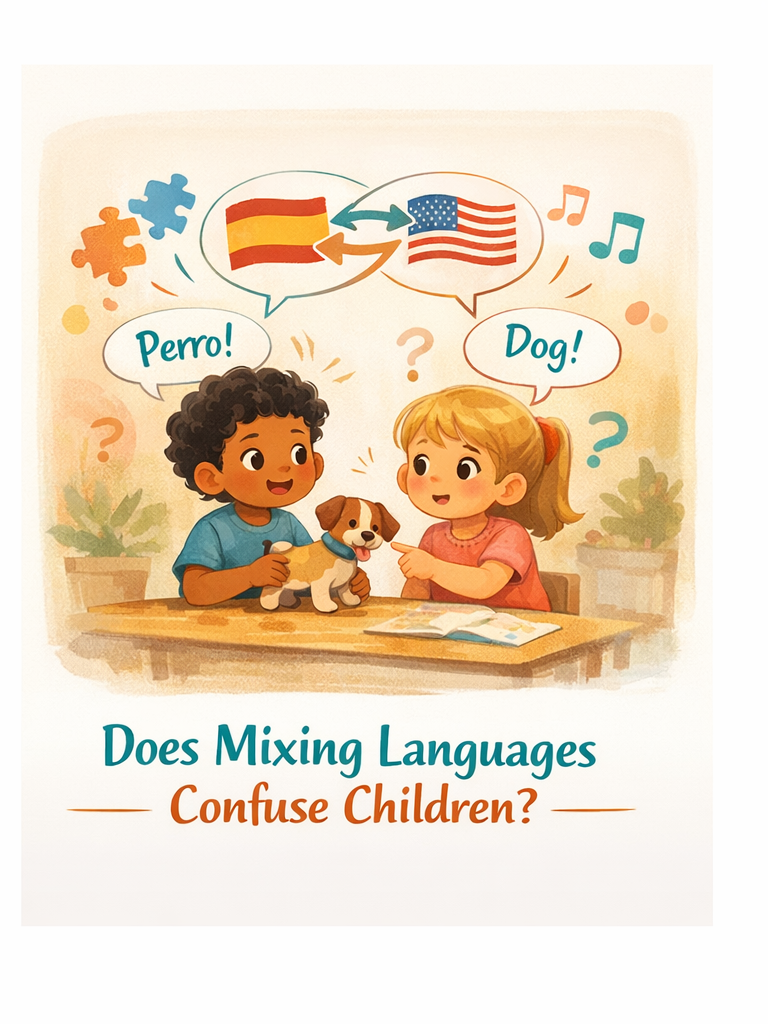
If you are raising a bilingual child, you may have heard this advice:
“Don’t mix languages. It will confuse them.”
It is one of the most persistent myths in multilingual parenting.
But research does not support this claim.
Why Children Mix Languages
When children grow up in multilingual environments, they may:
- Use words from both languages in the same sentence
- Switch languages mid-conversation
- Prefer one language in certain contexts
This behavior is known as code-switching.
Code-switching is not confusion. It is flexibility.
Children use the words that are most accessible in the moment.
What Research Shows
Research in bilingual development demonstrates:
- Bilingual children differentiate their languages early in development (Genesee, 1989).
- Code-switching reflects pragmatic skill, not cognitive deficit (Paradis, Genesee & Crago, 2011).
- Exposure to multiple languages does not delay overall language milestones when total language input is considered (Hoff et al., 2012).
Children raised with two languages are not confused. They are adapting.
Should Parents Separate Languages Strictly?
Some families prefer structured approaches such as:
- One-parent-one-language
- Context-based language separation
These approaches can help provide clarity. However, they are not mandatory for successful bilingual development.
Consistency matters more than rigidity.
When Mixing Is Not a Problem
Mixing languages is typical when:
- A child is under five
- Vocabulary is still expanding
- Both languages are present in daily life
Over time, as vocabulary strengthens, mixing often decreases naturally.
When to Seek Support
Consult a professional if:
- Vocabulary is limited across both languages
- There is difficulty understanding either language
- There are broader communication delays
Mixing alone is not a warning sign.
A Montessori Perspective
From a Montessori-aligned view:
- Children absorb their environment
- Language unfolds naturally
- Pressure interferes with expression
If a child mixes languages, observe calmly and continue modeling.
Final Thoughts
If your child says: “Quiero more milk.”
They are not confused. They are resourceful.
Children raised in multilingual homes are not confused by mixing.
They are building bridges between worlds.
Free Download: Mixing Languages Reassurance Guide
A printable, research-backed guide for multilingual parents and caregivers. Keep it, share it, revisit it.
Research & References
- Genesee, F. (1989). Early bilingual development: One language or two? Journal of Child Language.
- Paradis, J., Genesee, F., & Crago, M. (2011). Dual Language Development and Disorders.
- Hoff, E., et al. (2012). Dual language exposure and early bilingual development. Child Development.