
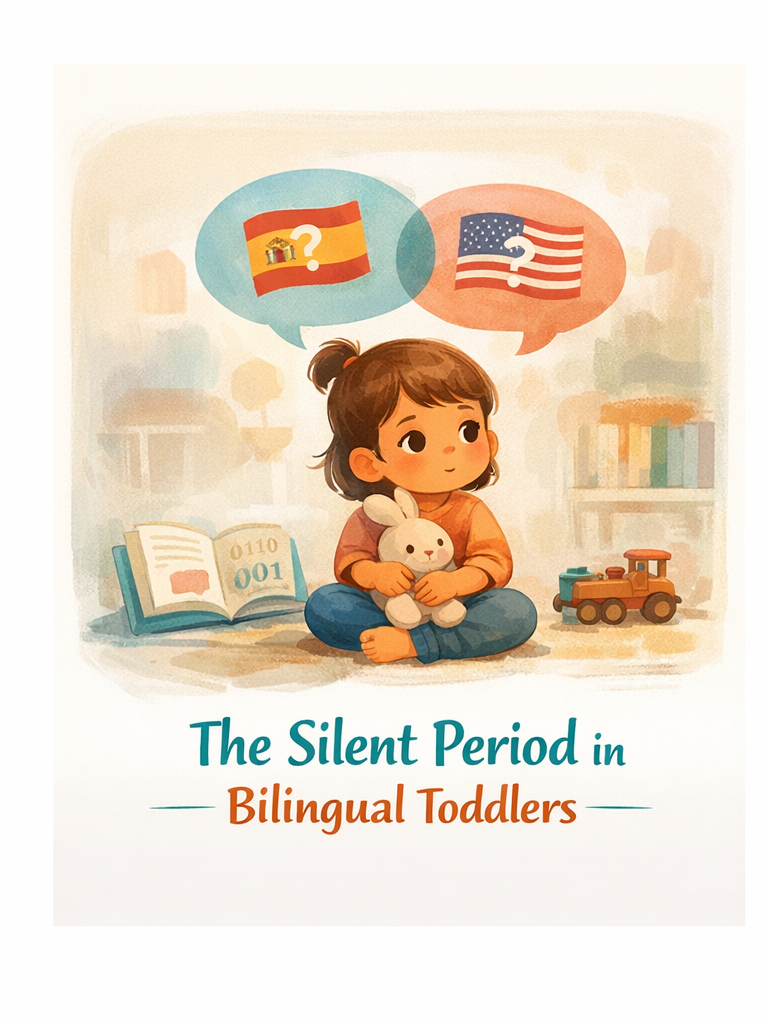
If you are raising a bilingual child, you may have experienced this moment:
Your child understands both languages. They follow instructions. They respond appropriately.
But when it comes time to speak, they choose only one language — or they stay quiet.
This phase is often called the silent period. And it is far more common — and far more natural — than many parents realize.
What Is the Silent Period?
The silent period is a stage in bilingual language development during which a child absorbs language before actively producing it.
In multilingual homes, toddlers are processing:
- Vocabulary in two linguistic systems
- Grammar patterns in parallel
- Pronunciation differences
- Social context cues
Even if they are not speaking both languages yet, their brains are actively organizing and storing them.
Understanding typically develops before expressive speech. This is not delay. It is preparation.
Why It Happens
Children learning more than one language often choose the language that feels easier, more socially dominant, or more reinforced outside the home.
If one language is used in school, media, or public spaces, it may emerge earlier in active speech.
The heritage or minority language may remain mostly receptive for a period of time.
This does not mean it is being lost. It means it is being processed.
What Research Suggests
Research in bilingual development shows:
- Receptive vocabulary often exceeds expressive vocabulary in early childhood (Tabors, 2008).
- Children may temporarily favor one language for production (Genesee, Paradis & Crago, 2004).
- Balanced exposure over time supports eventual expressive growth (Place & Hoff, 2011).
- Silent phases are common when children are acquiring an additional language (Krashen, 1982).
Language learning is not linear. It expands in layers.
Common Parental Concerns
Parents often worry: “Are we confusing them?” “Should we switch to one language?” “Are we falling behind?”
In most cases, the answer is no.
Consistency and emotional security matter more than speed. The goal is not early performance. The goal is long-term bilingual comfort.
How to Support Your Child During the Silent Period
1. Maintain Consistent Exposure
Continue speaking your heritage language regularly. Even if your child responds in another language, maintain your language calmly. Repetition builds familiarity.
2. Reduce Pressure to Perform
Avoid asking your child to “say it in Spanish” or “repeat after me.” Instead, model language naturally. Children are more likely to speak when they feel safe, not evaluated.
3. Increase Meaningful Context
Language tied to daily routines is more likely to stick:
- Mealtime words
- Bedtime phrases
- Play-based vocabulary
- Family expressions
When language is connected to emotion and environment, it becomes easier to retrieve.
4. Involve Familiar Voices
Children respond strongly to familiar voices. Grandparents, caregivers, and extended family members can provide additional exposure that feels relational rather than instructional.
Familiar tone builds confidence.
Montessori-Aligned Language Support
For families inspired by Montessori principles:
- Respect developmental timing
- Prepare rich language environments
- Allow repetition without interruption
- Follow the child’s lead
Language emerges when the child is ready.
When Should You Be Concerned?
Consult a pediatric professional if your child shows:
- No response to either language
- No gestures or communication attempts
- Regression across multiple developmental areas
Selective expressive use of one language alone is typically not a sign of delay.
A Long-Term Perspective
Bilingual development is a marathon, not a sprint.
Many children who speak one language exclusively at age three become fully comfortable in two languages by age six or seven — when exposure remains steady.
Your role is not to accelerate. It is to sustain.
Preserving Confidence and Connection
In multilingual homes, language carries culture, humor, family history, and emotional nuance.
The silent period is not absence. It is quiet growth.
Final Thoughts
If your child understands but does not yet speak your heritage language, you are not failing.
You are planting.
Continue speaking. Continue modeling. Continue inviting — without pressure.
Language rooted in connection tends to last.
Free Download: The Silent Period Support Guide
A calm, research-backed guide for parents navigating the receptive language phase — what to expect and how to keep showing up.
Research & References
- Tabors, P. O. (2008). One Child, Two Languages: A Guide for Early Childhood Educators of Children Learning English as a Second Language.
- Genesee, F., Paradis, J., & Crago, M. (2004). Dual Language Development & Disorders.
- Place, S., & Hoff, E. (2011). Properties of dual language exposure that influence bilingual development. Child Development.
- Krashen, S. (1982). Principles and Practice in Second Language Acquisition.
Published by NidoVoix — A family voice environment for multilingual homes.